QUT - Fundamentals of Mechanical Design (August 2022 - November 2022)
Designed, Modelled, and Built: Optimised Gearbox
Scroll ↓
As a team of three, we designed, manufactured, and analyzed a gearbox, aimed at lifting a 20kg max weight, by producing a specific torque increase, low-speed output, and optimal efficiency.
While not an eye-catcher, this gearbox performed as designed, attaining one of the highest efficiencies in the unit, and excelling in all criteria. Combined report and gearbox was graded a high distinction.
Design Process
Design choices regarding the prototype, focusing on mesh efficiency:
Spur Gearbox selected, as its cost-effective and multiplies its torque by transmitting motion and power through a series of meshing gears
Conservative gear analysis, assuming low-grade and rigid materials
Larger gear reductions at input shaft, as the output shaft experiences the highest stress due to pulley force
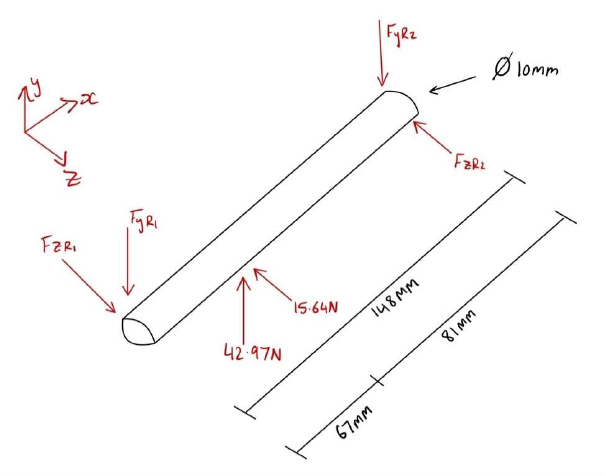
Shafts and gears are analyzed under static conditions with a reasonable factor of safety (FOS), minimum of:
3 for shafts as aluminum is adequate
1.2 for gears as acrylics rigidness and thin dimensions increase its critical nature
Modelling / Final Design
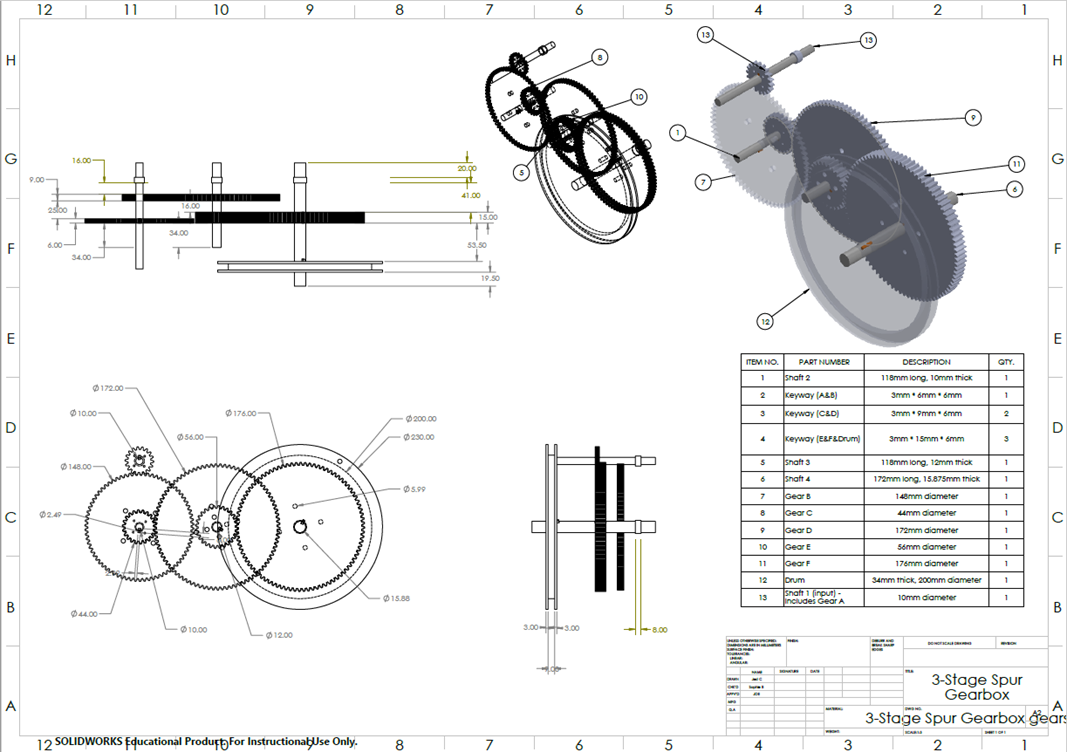
I used SolidWorks to formulate:
Designs for each part, and then appropriately assemble them
Technical drawings detailing dimensions and bill of materials for construction and laser cutting
Motion analysis verification to ensure gears operated as designed
Initial Build / Calculations
During initial construction, input gears [13] and [7]:
Restricted meshing, revealing miscalculations.
Redesigned to sit vertically, which reduced errors in drill hole positioning and correctly aligned gear meshing.
A reality case was analyzed, by assuming steel construction and conducting a fatigue failure evaluation of the shaft, gear teeth, and surface. Each components factor of safety (FOS) based on 2 years of perpetual operation was required to avoid failure (FOS<1).
Testing / Results
Tested with three speeds [400, 1000, 1400 RPM]
Gearbox successfully lifted 5kg, 10kg, 15kg, and 20kg producing an efficiency map revealing a minimum of 54%, and a maximum of 83.2% at 50x reduction
High efficiency given human construction and impractical materials
Supporting the gearbox’s success was smooth gear meshing due to redesigns during early construction, and the gear tooth-to-face width ratio allowing relatively thin gears to withstand higher loads.
Flaws involved, which affected efficiency:
Lack of stability, due to the housing material and base
Rectangular HDF pieces glued on either side of the walls proved susceptible to bending and cracks, causing a bolt to dig into the side
Gears encountered wobbles and off-alignments
Instead, a flat-based wooden design would provide consistent solidity over a cheap and quick HDF design.
Reflection ~ A project which improved my proficiency in Solidworks and design modeling, and my ability to successfully execute the engineering design process